
Why the same food product needs a different strategy in every market
A successful international food market strategy starts with a simple idea: the same product can have very different opportunities depending on where it is sold.
Imagine a food product with a strong identity, consistent quality and the potential to grow internationally.
Now take that same product to four different markets: Saudi Arabia, the United Arab Emirates, Andorra and Colombia.
Same product. Same quality. Same origin.
But should it be sold in exactly the same way?
Probably not.
Consumer expectations, purchasing habits, competition, pricing and distribution channels can vary significantly from one market to another. While the product may remain the same, the commercial environment around it changes.
The challenge is not simply deciding where to sell. It is understanding how the product can create value in each destination.

Saudi Arabia: Positioning Comes First
Saudi Arabia presents significant opportunities for international food brands, but choosing the right positioning is essential.
The Saudi FMCG market reached approximately $10.7 billion in the year ending April 2026. Recent NielsenIQ data also shows an interesting trend: both premium and value segments are growing, while products positioned in the middle face greater pressure.
For a food brand entering the Saudi market, this raises an important question:
Where do we want the product to compete?
A premium European speciality requires a different approach from a product focused primarily on value. Pricing, packaging, communication and channel selection should all support that positioning.
United Arab Emirates: Differentiation Matters
The UAE, and Dubai in particular, presents a different scenario.
Consumers have access to an extensive selection of international brands and imported food products. This creates opportunities, but it also means that being an international product is not enough to stand out.
The question becomes:
Why should a consumer, retailer or distributor choose this product over the alternatives already available?
A clear value proposition, distinctive presentation and the right sales channel can be decisive in such a competitive and international environment.
Andorra: Small Market, Specific Opportunity
Its proximity to Spain might suggest that Andorra requires little adaptation. However, geographical proximity does not mean identical market conditions.
Tourism, international visitors, gastronomy and the size of the market create a very particular commercial environment.
For certain food products, the opportunity may not be about achieving large volumes. Instead, it may depend on careful product selection, the right positioning and choosing the most appropriate points of sale.
A smaller market still requires its own strategy.
Colombia: A Shared Language Is Not a Shared Market
Colombia provides another interesting example.
Sharing a language makes communication easier, but it does not remove differences in consumer behaviour, distribution, competition or pricing.
The Colombian food retail sector reached approximately $52.7 billion in 2025, while its restaurant market is expected to exceed $14 billion by 2030, according to ProColombia.
There is significant potential, but entering the market successfully still requires understanding where the product fits, how it should be positioned and which channels offer the strongest opportunity.
One Product. Four Different Strategies
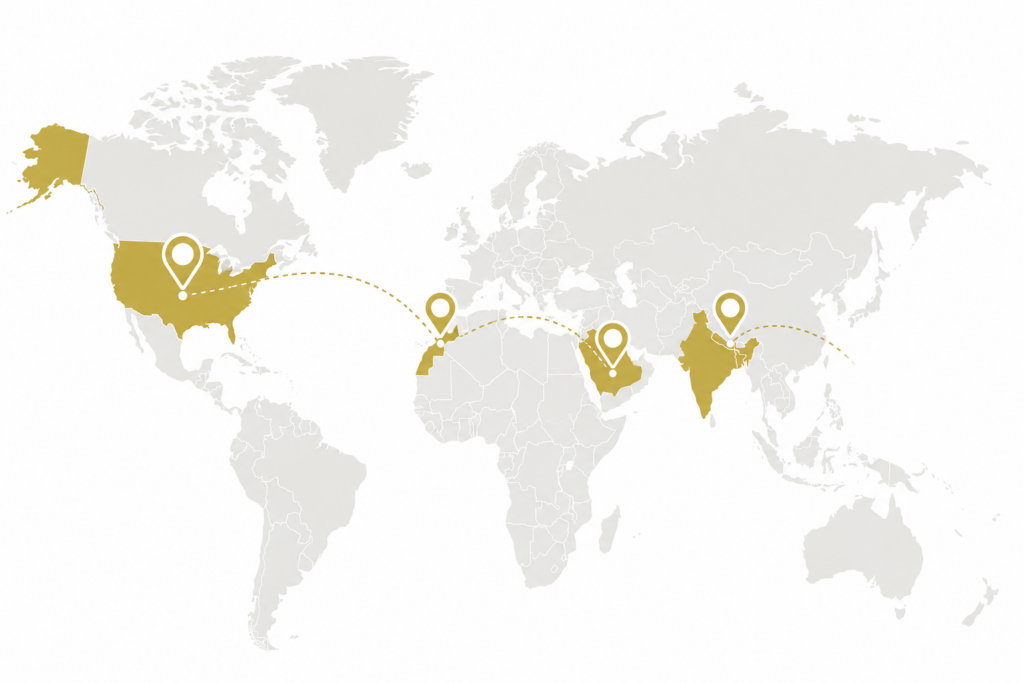
Before developing any new market, there are five questions worth asking:
Who will buy the product? Where will they find it? How should it be positioned? What will it compete against? And why should they choose it?
The answers will not necessarily be the same in Riyadh, Dubai, Andorra or Bogotá.
At MAGA Food, our international food market strategy starts with understanding this connection between product and destination. We analyse each market to identify where a product can create a real commercial opportunity and how it should be positioned to reach it.
Because international growth is not about placing the same product in different points on a map.
It is about finding the right place for that product in each market.
One product. Four markets. Four different strategies.